

Make a donation
Shannon topographic map
Click on the map to display elevation.
Make a donation
Shannon
The lower Shannon between Killaloe and Limerick had a topography quite different from the long upper reaches. Here the river falls by 30 m (98 ft) in only 20 km (12 mi). William Ockenden, also from England, was placed in charge of works on this stretch in 1757 and spent £12,000 over the next four years, without fully completing the task. In 1771 parliament handed over responsibility to the Limerick Navigation Company, with a grant of £6,000 to add to their subscriptions of £10,000. A lateral canal, 8 km (5 mi) long with six locks, was started but the company needed more funds to complete it. In 1791, William Chapman was brought in to advise and discovered a sorry state of affairs – all the locks had been built to different dimensions and he spent the next three years supervising the rebuilding of most of them. The navigation was finally opened in 1799, when over 1,000 long tons (1,000 tonnes) of corn came down to Limerick, as well as slates and turf. But even then, there were no tow paths in the river sections and there were still shoals in the summer months, as well as a lack of harbour facilities at Limerick, and boats were limited to 15–20 long tons (15–20 tonnes) load, often less.
Make a donation
About this map
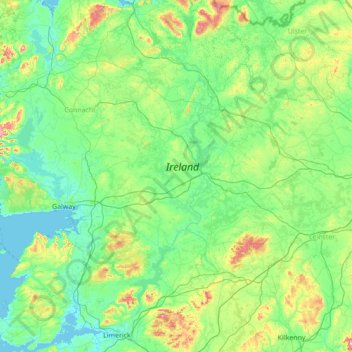
Name: Shannon topographic map, elevation, terrain.
Location: Shannon, Ireland (52.57852 -9.35448 54.23472 -7.87588)
Average elevation: 88 m
Minimum elevation: -2 m
Maximum elevation: 779 m
Make a donation
Other topographic maps
Click on a map to view its topography, its elevation and its terrain.


Make a donation

Make a donation


Ferns
Ireland > County Wexford > Ferns
The 19th-century population peaked in 1851, but never reached the levels of medieval times. Lewis's Topography of 1834 claimed the town "consists chiefly of one irregular street, and contains 106 houses indifferently built, retaining no trace of its ancient importance". The Abbey, St.Peter's Church (Catholic…
Average elevation: 60 m
Make a donation


Make a donation